Beauty revisited

A year after the upload of the of the “beauty” of Meskel square [see below], I am prepared to eat my words. It seems the inaccessibility has now been resolved and was mainly a symptom of the general unrest in the country. At this point, I would like to admit that the new Meskel square can in fact be a viable third-place for the middle class and upper class citizens of the city. Why, you might wonder did I bring up the socio-economic class of users?

My new-ish argument is the about the exclusivity of beautiful things and the inherent injustice of “improvement”. It is as if there is an implicit barrier in the usership of things perceived beautiful by the greater public. A simple example can be seen in the fashion industry, the service industry and of course in public spaces. Just as beautiful clothes are exclusive to the rich, so are beautiful public spaces. While beautiful is generally a very subjective term, I think a more objective interpretation can be applied to it when it is applied to spaces. one can reasonably argue that a forest is beautiful and a landfill is ugly without attaching the baggage of personal experience. It is with this generalized intention that I call Meskel square beautiful throughout this article. It is as a result of this beauty that the new and “improved” Meskel square inadvertently alienates a large portion of the population.

The argument might be made that it is, for all intensive purposes, open to everyone. But this ignores a fundamental flaw that is perpetuated by its “improvement”. As the program changed from public playground to distinguished hang-out, so has its user. it needn’t be put into words when the visuals speak plenty: this is no place for slumming it. It might seem like I’m arguing that Meskel square needs to go back to its less distinguished status to be welcoming to all, but my point is more a critique of the behavior that reinforces this belief. Well-to-do people feel as if they have a monopoly on comfort and this isn’t challenged by anyone. This is the trend we see in the gentrification of inner city residential areas. Once a place is seen as profitable, comfortable and beautiful, it no longer belongs the undeserving many but to the deserving few. In a capitalist world, improvement to spaces often means taking from the poor in service of the rich. Improved doesn’t only apply to the materials with which the streets are paved but also by the caliber of people who frequent its services.

Meskel square, is in my opinion, emblematic of the follies of the urban improvement mindset and with this Addis Ababa crawls deeper and deeper into the capitalist nightmare its leaders seem to desperately want it to become.
The “beauty” of Meskel Square

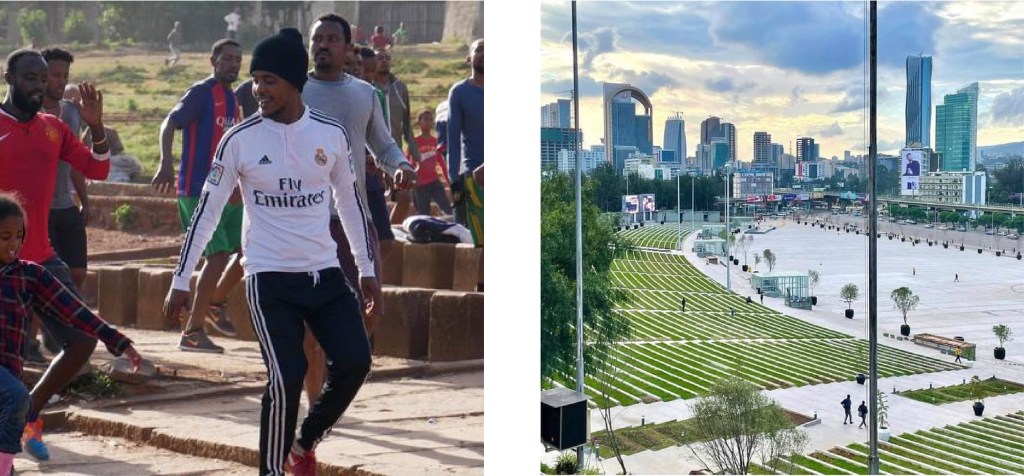
Meskel square was previously used to host different activities such as mass exercise initiatives (left), the current state of Meskel square (right)

Pretty doesn’t always mean good and there is no better example of this than the Meskel square renovation project. I have always loved going to stadium. As a child, it used to make me feel like an adult. Like I’ve been invited into the inner sanctum of adult existence. I loved the old buildings that surround the square, they felt like a physical representation of history. I loved the different functions hosted at the site and I loved how versatile and open it was. Now it is a true example of ruined perfection.

While Meskel square is as open as it has ever been (only in the physical sense), it has never been more closed off. It once stood as the site of congregation. It represented expression of opinion. It was a show of power and the will of the people. Now, I can’t think of a less attractive place to spend my time. Even if I had wanted to sit on the new concrete steps and enjoy the improvements, there is no way I could do that because this ‘public space’ is now under surveillance by armed guards for most of the day. If I had by some miracle been allowed to sit on the shiny benches there would be nothing for me to observe but frustrated drivers leaning on their horns and traffic jams that stretch out as far as the eye can see or I could simply stare at the barren ground that was once a muddy, active field. The community the space once hosted is now effectively dead. Once in a while there will be a fancy event of high ranking officials there to celebrate one thing or another but the square feels even more devoid of emotion at such events. With such an open view of the surrounding, one can’t help but notice the squadron of police vehicles standing-by. I will admit that the space now looks cleaner and more polished than it has ever been but I cant help but wonder when was that ever a priority for this place?

The appeal of Meskel square was not its aesthetic qualities. People gravitated towards it because of what it offered: a place to come together. I once saw a group of complete strangers come together on the small field for the first time in their lives and play a wonderful game of football like they have been friends since childhood. What it offered wasn’t glamour but camaraderie. It was a promise of equality. I don’t believe that anyone went to the old Meskel square hoping to sit on the ground and get up without being covered in dust. People knew exactly what they were going to get. They gathered because not only it was conventional but also because it was accessible and comfortable. Not to diminish the efforts of the government, but what good is new and improved if aesthetics takes precedence over functional and culturally relevant design? In its current state it reminds me of a pretty cake in a glass window. It is simply window dressing. I feel it would have spared so much taxpayer money to just hand every citizen a picture of the beautiful construction instead of building it so we can all glance at it once in awhile and be awed by its beauty. Lord knows none of us are going to be doing anything other than look and admire.  

It Takes a Village: The Role of Architecture in Community Building

Harar communal living compound
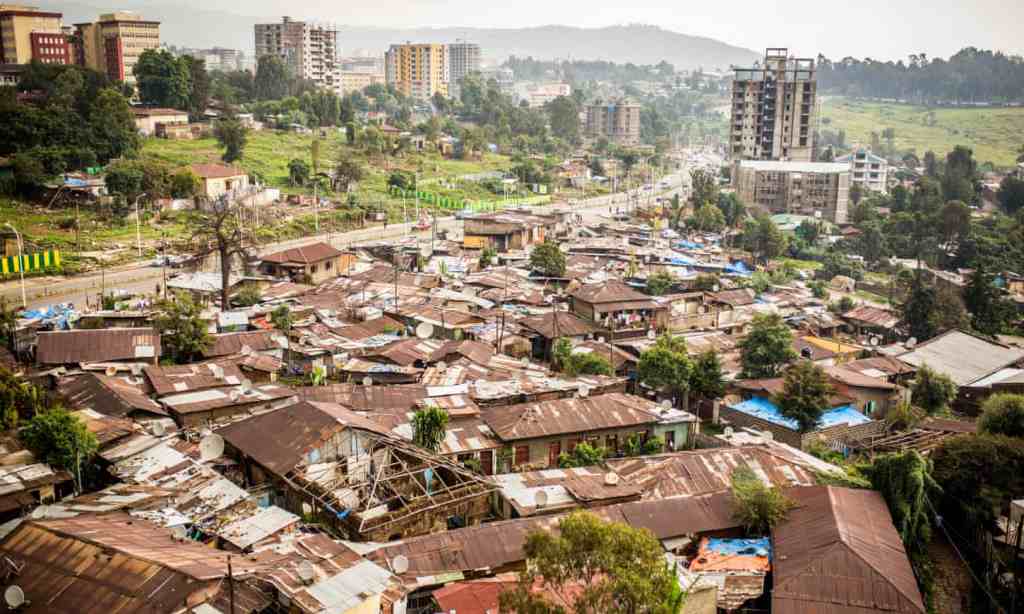
The slums of Piassa, Addis Ababa

Community means a lot to the people of my country. The culture is seeped with intricate social entanglements that span generations. Although Ethiopia is a third-world country with 23.5% of its inhabitants living under the poverty line, individuals persevere due to the collective effort of the community. Neighbors offer help in times of need, weddings and funerals are a collaborative effort, and holidays are organized to highlight the importance of society. The same communal spirit manifests through the utilization of architecture throughout history.

The architectural interpretation of the communal spirit prevalent in Ethiopian culture can be mapped through generations. As the priorities of the ancient empire evolved so did the the expression of space. The importance of community is especially evident in Harar. Harar is a small city in eastern Ethiopia which was once a renowned Islamic kingdom. The Harari people are known for their hospitality and generous spirit. As evidenced in their vernacular architecture, much importance is placed on the social fabric of the community. People are reliant upon one another to raise children, mourn losses, celebrate good times and partake in religious activities. Neighborhoods (Lasims in the local tongue) are a true portrayal of the importance of community. Each lasim has a group of houses with back to back support and narrow roads that lead to conventional gathering places. The houses often share a courtyard and other utilities. The structural support each house provides for the other is, in my opinion, a poetic interpretation of community. This organization of housing has resulted in the open nature of the residents. The inhabitants are less apprehensive of strangers and willingly share what they have. It is said no house is lacking as long as a neighbor lives.

While this practice of co-habitation is an efficient method of fostering strong communal ties, it is thought to be impractical in today’s climate, especially in Addis Ababa where overpopulation is a major concern. I must respectfully disagree. The implemented solution to this looming threat is construction of high-rise housing complexes. While the government’s dedication to provide housing is commendable, the European style construction segregates the residents socially and economically. To quote Alazar Ejigu, architect and urban planner, “the buildings fail to sustain people’s ordinary traditional way of life.” As more people flood into the city and more suburban settlements are established, the once flourishing neighborhoods of central Addis Ababa are being neglected, turned to slums and eventually gentrified. This disrupts the already established social bond of a living community. The residents are often relocated to above mentioned complexes where all semblance of a community is but an inkling. Culture is lost and meaningful interdependence is quashed.

As it is a more permanent form of artistic expression, architecture must play a role in the advancement of societal issues while serving functional needs. It is my hope that architecture will once again contribute to the social fabric of society.